Finish Your First Short Story in Ten Writing Sessions
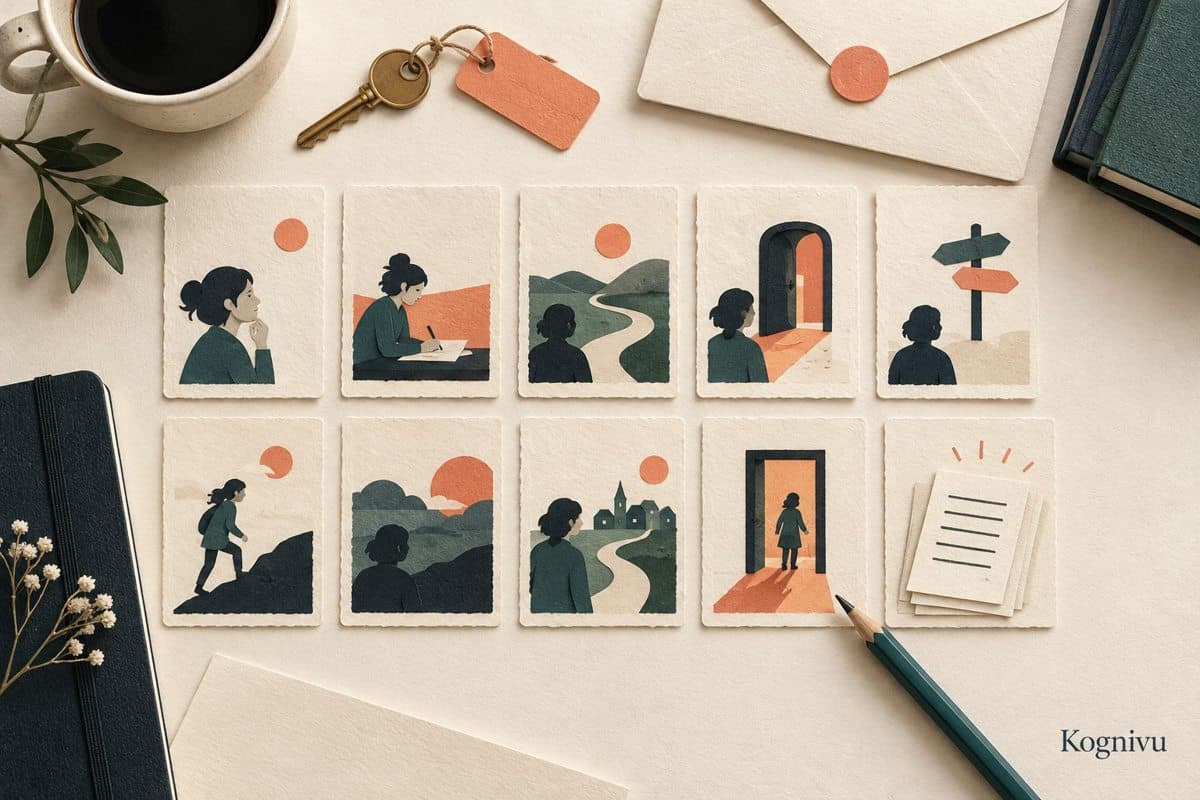
Turn one story idea into a complete draft with ten 25-minute sessions. Use a worked character-and-conflict example, scene checks, and a recovery plan for missed writing time.
Table of Contents
To finish your first short story, choose one character who wants something, put a specific obstacle in the way, and write through to the consequence of their choice. Keep the setting small enough to draft with the time you have. Save polishing the opening for a later pass, once the ending exists.
Try ten 25-minute sessions as a planning example: two to decide the story, six to draft it, and two to read the complete version and repair a confusing transition. That is 250 minutes of scheduled work, not a promise that every story takes that long. A rough beginning, middle, and ending is the finish condition for this attempt. A publishable story will usually need further revision and feedback.
Kognivu can turn a dated writing goal and your available time into a path with daily quests. You write the story in your own document and judge the result yourself. Plan your first story draft in Kognivu, then check that the suggested tasks move toward a complete draft rather than a larger collection of notes.
Make a character's problem small enough to finish
For this practice draft, use one viewpoint character, a short span of time, and a setting you can describe without days of research. Those are scope choices for the example, not rules that every short story must follow. If you are writing for an assignment or publication, check its actual length and format requirements first.
Here is an original fictional premise:
Mara must return a spare key before her neighbor leaves that evening. She has lost the key and knows the neighbor will ask where it went. She can invent an excuse or admit what happened and help resolve the problem.
The pressure is immediate: a departure time and a conversation Mara would rather avoid. You do not need to explain her entire childhood or invent a city to write the scene.
The Open University's character exercise starts with a character and a dilemma or conflict as a way to develop plot. Use that approach to turn an interesting person into someone who must act. It is one starting method; you can discover different possibilities while drafting.
Write four decisions in your notes:
- Mara wants to return the key without admitting she lost it.
- The neighbor needs to leave, so delaying the conversation has a cost.
- Mara first searches the wrong place, then considers lying about a dropped envelope.
- The ending will show what she does after choosing to tell the truth.
The last decision gives you somewhere to write toward. You can change the ending if the draft earns a better one. Keep a provisional destination so each new idea does not send you back to page one.
Sketch the action before expanding the background
For the key story, a compact scene outline might look like this:
| Moment | What Mara does | What changes because of it |
|---|---|---|
| Opening | Finds the empty key hook and checks the departure message | She has a problem with a deadline |
| First attempt | Retraces the walk home and searches her bag | Searching consumes the time she could use to help |
| Confrontation | Meets the neighbor at the door and starts an excuse | She must decide whether to continue the lie |
| Consequence | Admits the loss and offers a concrete next step | The neighbor responds; Mara has to act on her offer |
This is an outline for one story, not a formula to paste into every piece of fiction. The final response might be anger, relief, or an unexpected complication. Choose what fits the characters you actually wrote.
Test the outline by reading only the right-hand column. If it repeats "Mara is worried" four times, the story needs a change in circumstance or a decision. Worry can be present, but the next scene should have a reason to happen.
When you need help making a task smaller, use the distinction in breaking goals into tasks: "work on my story" leaves the next action unclear; "draft the conversation at the door through Mara's admission" names a piece you can inspect.
Give each writing session an output
Put the ten blocks on your calendar before choosing the deadline. Five available sessions each week would make this a two-week plan. Three each week would need longer. Use the sessions you can protect, rather than assuming you will write every evening.
| Session | Write or decide | Check before stopping |
|---|---|---|
| 1 | Choose the character, desire, obstacle, and small setting | You can explain the immediate problem in a few sentences |
| 2 | Sketch the sequence and a provisional ending | Each moment changes what can happen next |
| 3 | Draft the opening in your chosen viewpoint | The reader can tell who is present and what is wrong |
| 4 | Draft the first attempt to solve the problem | The attempt has an observable result |
| 5 | Continue into the complication | The next decision is harder or different |
| 6 | Draft the confrontation | The character makes or avoids a meaningful choice |
| 7 | Write the immediate consequence | The choice affects what happens |
| 8 | Reach the ending and bridge any missing scene | There is a readable route from beginning to ending |
| 9 | Read the whole draft without fixing every sentence | You have a short list of confusing or missing connections |
| 10 | Repair the most serious connection and save a version | A reader can follow the action without your spoken explanation |
If a scene fits in one block, continue to the next unfinished part. If it takes longer, keep its check and adjust the schedule. A timer measures a work block; it does not prove that the scene is complete.
At the end of each session, leave one sentence for your next start: "Mara is at the door; next, write what she says when the neighbor asks for the key." That note is more useful than rereading your entire notebook tomorrow.
Park the sentence that keeps stopping you
During the first drafting pass, mark a detail you cannot settle and continue. A note such as "[describe the hallway sound]" can wait while you write the conversation. A missing action that makes the ending impossible needs attention sooner.
In the example, the exact color of the envelope is optional. Whether Mara has already told the neighbor she returned the key changes the confrontation. Repair that continuity before adding descriptions.
Keep a separate revision list so an awkward sentence does not become a new project. After the complete draft exists, read for viewpoint, cause and effect, pacing, and language. The Open University's introductory fiction course offers further work on character, setting, and genre. Choose a relevant exercise for the problem you found, rather than restarting the whole learning process.
Recover the draft when two sessions disappear
Suppose you finish sessions 1–5, then miss two blocks. You now have three available sessions before your original deadline and five planned outputs still unfinished. Do not squeeze five separate tasks into three blocks by changing their labels.
Choose between moving the deadline and reducing the draft's scope. If you keep the date, use one remaining block for the confrontation, one for the consequence and a rough ending, and one to connect the scenes and read the whole draft. Leave line editing for a later revision period. If those blocks cannot produce a readable draft, extend the date. The goal remains the complete story, not ten checked boxes.
For the key story, you might remove a planned scene involving a second neighbor. Keep the choice at the door and its consequence; those carry the problem you set up. If removing a scene makes the ending confusing, repair the outline before writing more.
Kognivu lets you review progress, edit your goal or schedule, and ask Coach for help. Missed writing is not automatically rescheduled. Inspect the proposed tasks when your time changes. For the broader problem of returning to unfinished work, restarting a project after a long break covers how to locate the next useful action.
Save the complete draft with a version name you can find again. Then ask a reader what Mara wanted, where they lost track of the action, and what they understood from the ending. Their answers give you specific revision work; "is it good?" is harder to act on.
Build my story-drafting goal in Kognivu with the real deadline, the draft you have, and the sessions available. Review the generated path and first quest before deciding on ongoing use. The free preview includes one generated path, three generated quest completions, and five Coach messages, with no card required; ongoing use requires a paid plan.
Written by
Ilia Sorokin
Expert in Learning & Career and deterministic planning systems. Building tools to bridge the gap between ambitious goals and daily execution.
Kognivu editorial team
Next step
Need product path, not just theory?
Use Kognivu as a daily planner for goals when a normal to-do list is not enough. Build momentum with pre-decided quests and measurable execution.
Explore Daily Planner for Goals That Need Real Follow-ThroughContinue Reading
More from Learning & Career