How to Break Down Goals Into Tasks With AI That Works

Need to break down goals into tasks without getting lost in planning? This AI framework turns a big outcome into milestones and daily actions. Learn how.
Table of Contents
If you want to break down goals into tasks, you do not need more motivation. You need better compression.
Most people already know the outcome they want:
- launch the product
- pass the exam
- lose the weight
- build the portfolio
- switch careers
The real problem starts one layer lower. The goal sounds clear, but the work does not. So you sit down, look at a giant objective, open six tabs, make a vague list, and call that planning.
That is where execution dies.
This guide shows you how to break down goals into tasks in a way that survives real life. Not a pretty brainstorm. Not a giant Notion page. A usable system that turns one meaningful goal into milestones, working sessions, and daily actions you can actually finish.
What does it mean to break down goals into tasks?
Breaking down goals into tasks means converting a desired outcome into smaller units of work that are specific, sequenced, and executable under real constraints. A good breakdown does not just list ideas. It defines what to do next, how big the task is, and how that task moves the goal forward.
That last part matters.
A lot of people do create tasks. They just create bad ones.
"Work on portfolio." "Study SQL." "Fix marketing." "Get in shape."
Those are not tasks. They are categories. A task should be small enough to start without another round of interpretation.
Good example:
- rewrite homepage hero around one ICP and one promise
- complete 20 SQL join practice questions
- walk for 30 minutes after lunch on Monday, Wednesday, and Friday
- record one project walkthrough for your portfolio site
If you still need to decide what the task means when you sit down to do it, the breakdown is incomplete.
Why most goal breakdowns fail
Most advice on this topic is weirdly useless because it stops at "make smaller steps."
That is directionally true. It is not operational.
Goal breakdowns usually fail for four reasons:
1. The goal is outcome-shaped, but the plan is not
"Get a data analyst job" is an outcome. It is not a project plan.
You still need the bridge:
- resume rewrite
- portfolio projects
- SQL practice
- interview prep
- applications pipeline
Without that middle layer, the goal stays emotionally important and mechanically empty.
2. Tasks are too big to start
This is the classic mistake.
People write tasks like:
- build MVP
- prepare certification plan
- do outreach
- improve health
Those are not tasks. They are mini-goals wearing task clothing.
Big tasks create friction before execution even begins. You sit down to "build MVP" and immediately need to decide what part, what scope, what dependency, what success condition, and how long to spend. That is five extra decisions before the work starts.
3. No sequence, only a pile
A flat task list looks productive right up until you try to use it.
If everything is listed at the same level, you still have to choose:
- what comes first
- what can wait
- what depends on something else
- what matters this week
That is why task managers often become storage, not execution.
4. The plan ignores actual capacity
This is the quiet killer.
A task breakdown that assumes you have three focused hours every weekday will fail if your real life supports forty-five minutes after work and one deeper block on Saturday.
Planning against fantasy capacity creates fake urgency, then guilt, then replanning, then avoidance.
Goal vs project vs milestone vs task
This distinction cleans up a lot of confusion.
| Layer | What it means | Example |
|---|---|---|
| Goal | The outcome you want | Get a product marketing role in 120 days |
| Project | A major workstream inside the goal | Build application assets |
| Milestone | A checkpoint that proves progress | Finish resume, LinkedIn, and portfolio case study |
| Task | One concrete unit of work | Rewrite resume bullets for last two roles |
If you skip straight from goal to task, the breakdown often feels random.
If you stay too long at the goal and project level, nothing gets done.
The middle layer is what makes the system work.
How to break down goals into tasks in 5 steps
A good breakdown should leave you with a short list of tasks you can execute this week, not a giant graveyard of someday intentions.
1. Define the goal as a finish line, not a vibe
Bad goal:
- get better at design
Better goal:
- publish a portfolio site with 3 strong case studies by September 30
The goal needs a result, a scope, and a date.
If the finish line is vague, the breakdown will stay vague too.
2. Split the goal into 3 to 5 workstreams
This is where you stop treating the goal like one giant blob.
For a career-switch goal, the workstreams might be:
- skill building
- proof of work
- market positioning
- applications and outreach
- interview practice
For a fitness goal, the workstreams might be:
- training
- nutrition
- recovery
- adherence tracking
This step matters because it prevents the breakdown from collapsing into one overstuffed list.
3. Turn workstreams into milestones you can verify
Milestones should prove something changed.
Bad milestone:
- make progress on portfolio
Good milestone:
- publish case study one with screenshots, metrics, and final live link
Bad milestone:
- study for exam
Good milestone:
- finish networking module and score at least 80% on two timed practice sets
If you cannot tell whether the milestone is done, it will stay in permanent motion.
4. Break each milestone into tasks you can start cold
This is the real craft.
Use this test:
Could you start the task in under 60 seconds without needing to plan it again?
If the answer is no, the task is still too big.
Examples:
- "Build portfolio case study" becomes "write problem statement for project A"
- "Study SQL" becomes "complete 15 aggregation questions and review mistakes"
- "Launch blog" becomes "draft intro and first two H2s for article one"
One useful pattern here is to write tasks with an action verb, an object, and a boundary:
- draft 5 resume bullets for analytics project
- review 20 flashcards on VPC networking
- record one 3-minute mock interview answer
- outline landing page sections for ICP A
The psychology term behind this is implementation intention: deciding the action and context in advance instead of improvising when the moment arrives. A meta-analysis covering 94 independent tests found a medium-to-large positive effect on goal attainment for implementation intentions. That matters because a concrete task is easier to start than a vague ambition. (Source)
5. Sequence the next seven to ten days only
This is where many people overdo it.
You do not need a perfect ninety-day task list on day one. You need enough structure to move without thinking every morning.
Plan the next seven to ten days at execution level. Keep the rest at milestone level until you get closer.
Why? Because long-range task detail decays fast. Reality changes. Tasks expand. Priorities shift. The deeper you get into fake precision too early, the more time you waste maintaining the plan instead of using it.
A simple example of goal breakdown
Let us take a concrete goal:
Goal: Get interview-ready for a product marketing role in 8 weeks.
Workstreams:
- positioning
- portfolio proof
- interview stories
- applications
Milestones:
- rewrite resume and LinkedIn for product marketing framing
- publish one case study page
- prepare six strong STAR stories
- apply to 25 relevant roles
Tasks for this week:
- Rewrite top resume summary for PMM target roles.
- Rewrite three bullets from most relevant past role.
- Collect screenshots and metrics for one case study.
- Draft case study outline with problem, action, outcome.
- Write STAR story for product launch example.
- Save 15 target job postings and extract repeated requirements.
That is a usable breakdown.
Notice what it does not include:
- "become more employable"
- "work on applications"
- "improve confidence"
Those are real concerns. They are not executable tasks.
How AI helps break down goals into tasks
This is where AI can be genuinely useful and where a lot of tools still fall short.
Bad AI planning gives you polished summaries and vague encouragement.
Good AI planning does four harder things:
It builds the missing middle layer
A useful AI system should not jump from "learn Python" to "do coding today."
It should generate the structure in between:
- modules
- milestones
- dependencies
- daily tasks
That middle layer is exactly what most people fail to build consistently on their own.
It shrinks oversized tasks automatically
If the plan says "prepare for technical interview," the AI should keep decomposing until the work becomes real:
- solve two array questions
- write one verbal walkthrough
- review mistakes from yesterday
This is the difference between an execution engine and a chat toy.
It respects time budget
A good breakdown is not just logically correct. It fits the actual week.
If you have sixty minutes tonight, the task list should match sixty minutes tonight. Not a fantasy block designed for your idealized self.
This is one reason people searching for an AI daily planner or AI weekly planner are really searching for constraint-aware breakdown, even if they do not use that phrase.
It replans when you slip
This is the part people underestimate.
Breaking down goals into tasks is not a one-time event. The real problem is what happens after missed days, urgent work, travel, low energy, or plain life chaos.
If the system cannot re-sequence the plan after disruption, it does not really solve execution. It just makes the original breakdown look clean.
Where Kognivu fits
Kognivu is built for exactly this translation problem.
You set a goal, a deadline, and the time you can realistically give each day. Then the AI Architect maps the goal into workstreams, milestones, and daily quests. The AI Coach keeps the plan moving when the week gets messy.
That is a more useful model than a blank planner because the hardest part is rarely writing tasks down. The hardest part is deciding what the next right task is without burning energy on interpretation.
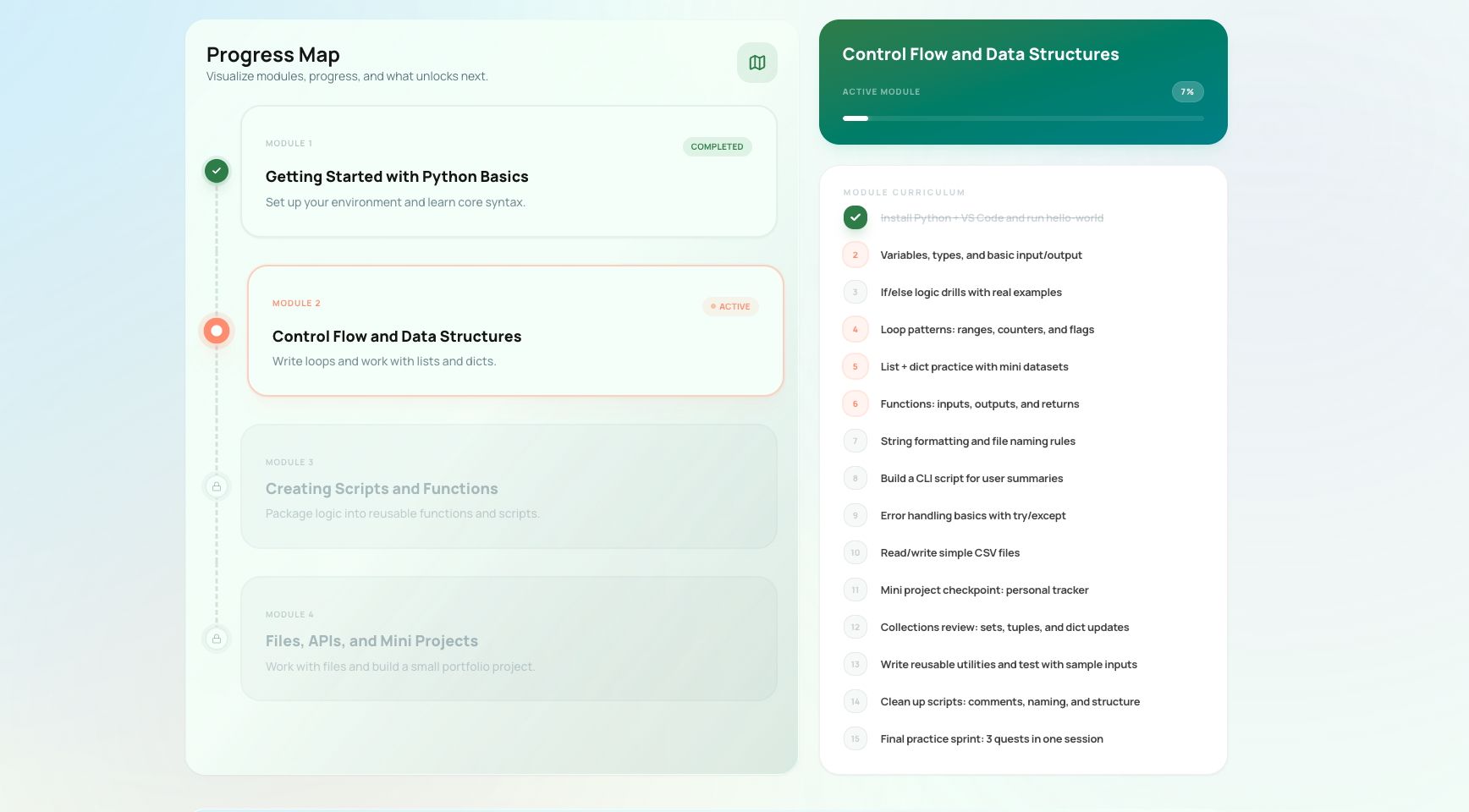
Kognivu's roadmap view turns one large goal into visible modules and milestones so daily work stops feeling random.
If you are already feeling task overload, start with AI task planner for overwhelm. If your current system tracks goals but never tells you what to do next, why goal tracking apps fail will probably feel familiar.
Common mistakes when breaking down goals into tasks
These mistakes show up constantly:
Mistake 1: Breaking everything down at once
This feels productive. It usually is not.
You do not need 140 tasks on day one. You need the next few milestones and the next few days of clear work.
Mistake 2: Writing tasks with no finish condition
"Research competitors" can expand forever.
Better:
- review 5 competitor homepages and capture 3 repeated claims
Now the task can end.
Mistake 3: Mixing outcome tasks and maintenance tasks
"Go to the gym" and "write pricing page draft" are both valid tasks, but they play different roles.
One maintains the system. The other advances a project.
If you do not distinguish them, your week can look full while the real goal barely moves.
Mistake 4: Letting the plan become a guilt archive
If you keep copying overdue tasks forward for three weeks, the issue is not discipline. The issue is task design, sequencing, or capacity mismatch.
This is where a better system beats more self-criticism.
The practical rule to remember
Here is the rule I would keep:
A goal breakdown is good when today's task is obvious.
Not interesting. Not inspiring. Obvious.
When the task is obvious, starting gets easier. When starting gets easier, consistency stops depending on mood. That is the whole game.
You are not trying to create the world's most elegant plan. You are trying to remove enough ambiguity that execution becomes the default move.
Ready to Turn Your Goals Into Daily Action?
Kognivu is an AI-powered life coach and daily planner that does exactly what this post describes: it breaks your goal into a structured roadmap, then delivers clear daily quests to keep you moving.
Build your execution plan and start immediately. Plus and Pro include a 3-day trial.
Written by
Ilia Sorokin
Founder of Kognivu. Writes about personal goal planning and reviewing AI-generated plans.
About the authorNext step
Need product path, not just theory?
If goal tracking apps keep showing data without changing behavior, Kognivu offers a more active execution-first alternative.
Explore Alternative to Passive Goal Tracking AppsContinue Reading
More from Productivity Systems