Revise Your Essay Draft Before You Polish the Sentences
Turn an essay draft into a concrete revision plan. Use a paragraph map to find a missing argument, choose the next edit, and check the revised version.
Table of Contents
To revise an essay draft, read the assignment again, map what each paragraph actually does, and repair the biggest gap between your argument and its support. Check the revised argument before editing sentences and proofreading. If you begin by swapping words in the introduction, you may spend your available hour polishing a paragraph you later remove.
Start with a saved copy of the draft. Write one finish condition: for example, "A reader can follow my recommendation, find the evidence behind it, and understand the strongest objection." Your assignment's requirements still decide what belongs in the essay.
Kognivu can help divide the remaining revision work into quests around your deadline and available sessions. Keep the essay, sources, and revision notes in your own document editor. Plan your essay revision in Kognivu, then check that the proposed tasks address the actual draft. Planning a revision does not verify an argument or its citations.
Find the problem that changes the paper
Read once without correcting every sentence. Note where you cannot follow the reasoning, where a claim has no support, or where the paper answers a different question from the assignment. Mark source checks explicitly so an uncertain detail does not become an accepted fact through repetition.
The UNC Writing Center's revision guidance distinguishes reconsidering a paper's ideas from its final proofreading. Use that distinction to choose your first job. An unsupported recommendation needs work before its punctuation does.
Try this diagnosis:
| What you notice | A concrete next edit |
|---|---|
| The introduction promises a comparison, but the body describes only one option | Add the required comparison or narrow the claim if the assignment permits it |
| Two paragraphs give the same reason | Combine them and retain the evidence that matters |
| A quotation appears without an explanation | Explain how that passage supports the paragraph's claim |
| A strong objection appears only in the conclusion | Develop it where the reader needs it and reconsider the recommendation |
| The argument works, but a sentence is hard to follow | Rewrite that sentence during the language pass |
Choose one substantial repair first. "Improve the essay" is too vague to tell you when a session is done.
Map the draft you wrote
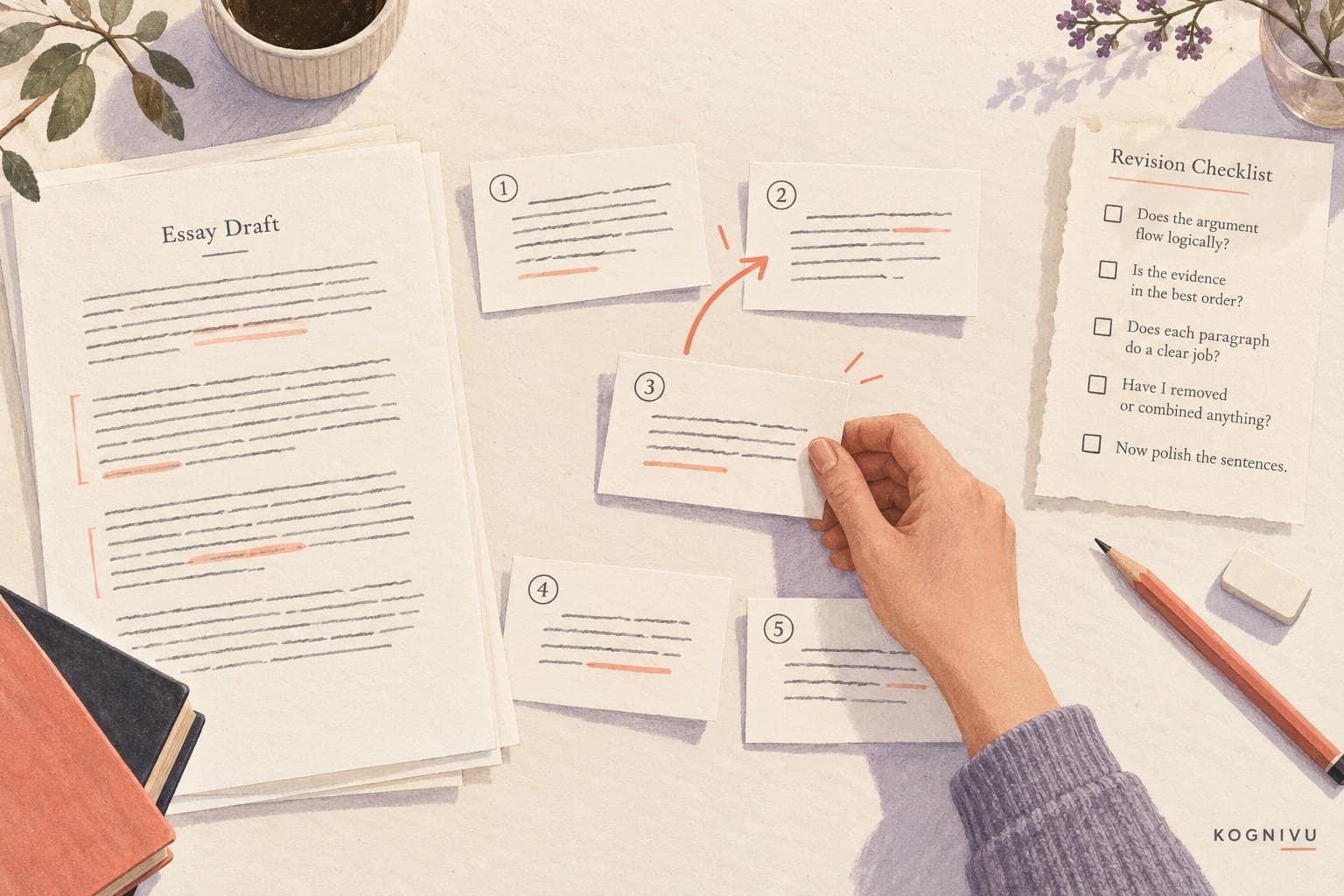
Number the paragraphs. Beside each number, record its point and its job in the argument. Purdue OWL describes reverse outlining as a way to inspect paragraph focus and contribution. Your map should describe the existing draft, including the awkward parts. An ideal outline from before you wrote it can hide those problems.
Here is an original fictional example. A student has been asked to recommend whether a campus library should trial a later closing time. The draft argues for opening until midnight every day, but the student has evidence only about a few weekday evenings. No library survey or usage figures below are real research findings.
| Draft paragraph | Point and job | Revision decision |
|---|---|---|
| 1 | Recommends midnight opening every day | Revisit after checking the evidence's scope |
| 2 | Describes students wanting quiet space after evening classes | Keep as the proposed need; verify the cited source |
| 3 | Repeats that students need quiet space | Combine with paragraph 2 |
| 4 | Mentions staffing costs, then dismisses them | Develop the objection; do not invent a cost estimate |
| 5 | Concludes that longer hours will improve grades | Remove the unsupported outcome claim |
The map exposes two missing pieces: why this schedule rather than another one, and how the proposal handles the staffing objection. Adding a smoother transition will not supply either answer.
The student could investigate those questions and defend the original proposal. If the assignment permits a narrower recommendation, another route is a limited weekday trial with an explicit evaluation plan. That choice still needs evidence and reasoning; calling something a "trial" does not make it free or feasible.
Turn one diagnosis into an edit you can check
Write a revision note with a location, an action, and a test. For the fictional essay:
Location: Paragraph 4 and the recommendation in paragraph 1.
Problem: Staffing cost is acknowledged but never considered.
Action: Explain the constraint, check the available source, and compare
        a limited weekday trial with the original daily proposal.
Test: A reader can identify the trade-off and why the chosen scope follows.
Unresolved: Actual staffing capacity and cost; find a credible source
            or state the limit rather than guessing.
Now make the edit in a new version. A possible revised recommendation is: "The library should consider a later-closing trial on the weekdays identified by the evidence, subject to staffing feasibility, and evaluate use before extending the schedule." Whether that recommendation is justified depends on the student's actual sources and assignment. It is a working sentence to test, not a ready-made conclusion to paste into another paper.
Follow the change through the whole draft. A narrower introduction cannot coexist with a conclusion promising better grades for all students. Check the heading, examples, and conclusion for claims left over from the earlier version.
Spend the available sessions on separate outputs
Suppose you have three half-hour sessions before submission. Use this as a starting budget, then adjust it to the draft:
- Read the instructions, map the paragraphs, and select the largest repair. Save the map and a specific revision note.
- Repair that argument and check its sources. Save a complete revised version with unresolved points visibly marked.
- Read the whole paper, test the reasoning, then edit language, citations, and formatting against the requirements.
Ninety minutes may be insufficient for new research or a major rewrite. If the evidence is missing, spend time finding it and reduce an optional example, or seek guidance about scope or the deadline. Do not solve the time shortage by inventing support. For a broader workload problem, catching up on studying without cramming helps decide what work to preserve.
After each session, leave a restart note such as "Check whether paragraph 2's source covers weekdays only." Keep it beside the document so the next session begins with an action rather than a full reread. If a source is difficult, the research-paper reading guide explains how to trace a claim to the evidence and record what remains uncertain.
Check whether the revision worked
Close your paragraph map and read the new draft as a reader. Can you state its main claim? Does each section help establish it? Is the evidence relevant to the exact claim, and have you explained the connection? Can you find the objection and understand the response?
Ask a reader a specific question: "Where did the recommendation stop making sense?" Their answer gives you a location to inspect. Agreement with your conclusion alone does not establish that the reasoning is clear.
If you use AI feedback, check your course's rules first. Treat suggestions as proposals, locate any cited evidence yourself, and decide whether each edit preserves your meaning. Keep responsibility for the argument and submitted work.
Finish by checking quotations against their originals, completing source details, reading difficult sentences aloud, and confirming submission format. Save the final file under a clear version name and open that exact file before submitting it. A completed revision has a readable argument and checked requirements, not just a long history of edits.
Build my essay-revision goal in Kognivu with the draft's current state, deadline, and real available time. Review the generated path and first quest against your revision note; keep source checking and final submission in your writing workflow.
Written by
Ilia Sorokin
Founder of Kognivu. Writes about personal goal planning and reviewing AI-generated plans.
About the authorNext step
Need product path, not just theory?
Use Kognivu as a daily planner for goals when a normal to-do list is not enough. Build momentum with pre-decided quests and measurable execution.
Explore Daily Planner for Goals That Need Real Follow-ThroughContinue Reading
More from Learning & Career