Behavioral Interview Examples You Can Actually Defend
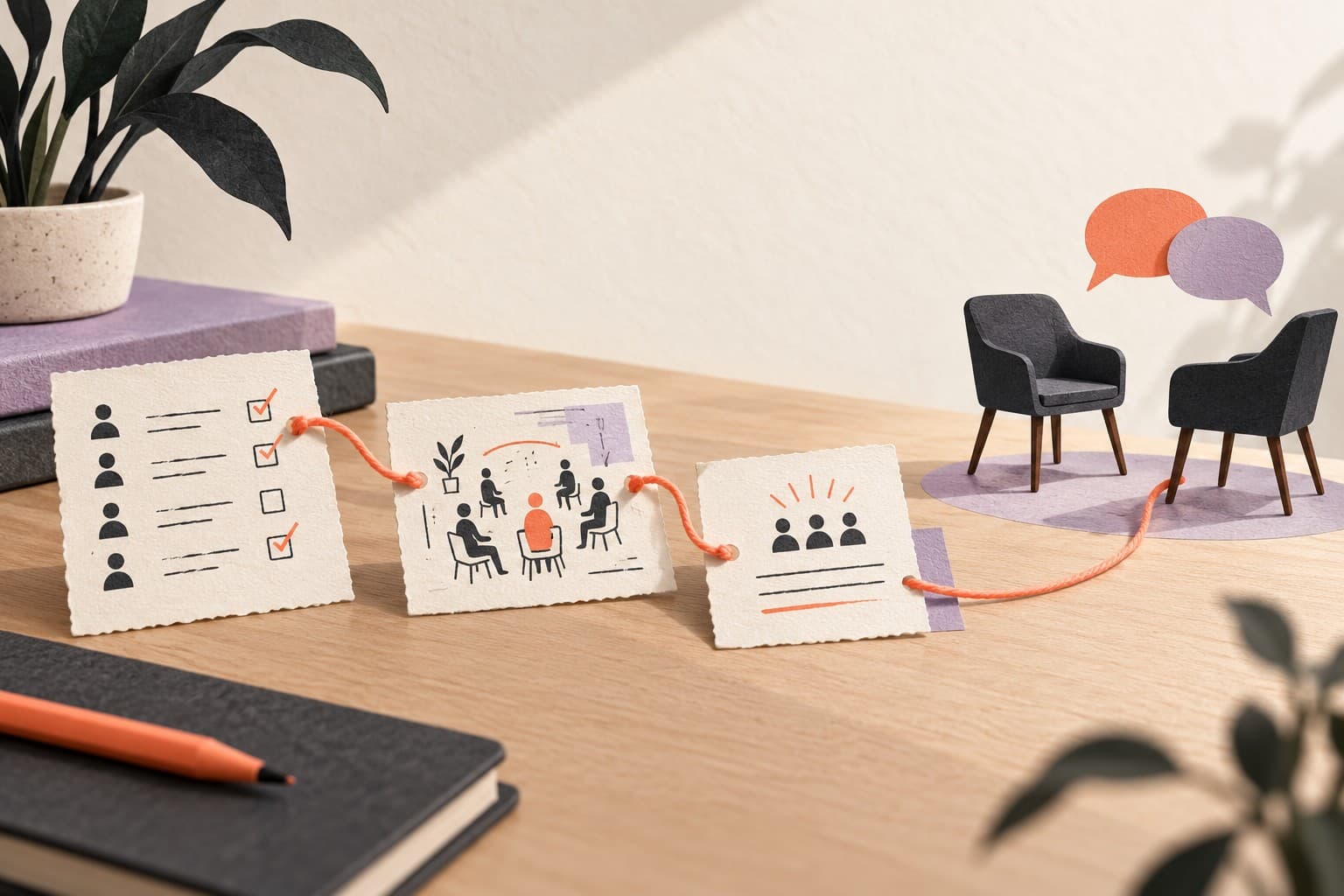
Prepare honest behavioral interview examples: choose relevant experiences, explain your own actions, check the outcome, and practice answering follow-up questions.
Table of Contents
To prepare behavioral interview examples, read the role's requirements, choose specific experiences that show those skills, and outline what happened, what you personally did, and what followed. Practice answering a question from those notes, then check whether you can explain your decisions under follow-up. A polished story loses its value if the details are borrowed or the outcome is exaggerated.
You do not need a dramatic rescue story. A class project, part-time job, volunteer shift, or personal build can provide a useful example when it fits the question. The task is to make your contribution clear enough for another person to understand and ask about.
Kognivu can help turn the preparation into daily quests using your interview date and available sessions. Keep the actual stories and supporting details in your own notes. Plan your interview practice in Kognivu, then check that the proposed work includes speaking practice and feedback. The app can help organize the work; it cannot verify your employment history or promise an offer.
Choose experiences for the role you are discussing
Start with the job description. Pick a few responsibilities or skills you may need to demonstrate, such as resolving a disagreement, explaining a confusing process, or learning from a mistake. Use the employer's actual requirements rather than collecting answers to every interview question online.
Harvard's interviewing guidance explains that behavioral questions ask for a specific situation and your actions, with examples available from work, school, extracurricular activities, or volunteering. Your example needs to answer the question, not merely sound impressive.
Make a small inventory before drafting a response:
| Role requirement | Experience worth checking | Your contribution to explain |
|---|---|---|
| Coordinate with other people | A volunteer event with a confusing check-in process | How you agreed on one procedure with another volunteer |
| Learn from feedback | A class presentation you revised after a tutor's comments | What you changed and how you checked the revision |
| Handle an obstacle | A personal project with a broken dependency | How you diagnosed the blocker and adjusted the scope |
These are prompts to recall your own experience, not stories to claim. Select an example only when you can remember the situation, distinguish your work from someone else's, and explain the result honestly. If you do not have evidence of leading a team, choose a relevant contribution you did make rather than promoting yourself to team leader.
Use STAR to make your actions visible
STAR stands for Situation, Task, Action, and Result. Situation gives the necessary context; Task states your responsibility; Action explains what you did and why; Result describes the outcome and what you learned.
MIT's STAR guidance puts most of the answer's emphasis on your actions. It recommends a small set of stories in bullet notes and warns that memorized scripts can make it harder to adapt. Treat the structure as a way to explain an experience, not a requirement to announce four labels aloud.
For each story, save enough facts to support an answer:
Question or skill this could address:
Context the listener needs:
My responsibility:
What I personally did, in order:
Why I chose that approach:
What other people contributed:
Observed outcome and its limits:
What I learned or would change:
Details I need to check before using this story:
Most of the useful detail belongs in your actions. "We communicated better" leaves the interviewer guessing. "I asked the other volunteer to compare our lists, found that one was an older copy, and agreed which list we would both use" gives them something concrete to assess.
Work through one example without inflating it
Here is an invented practice story about a community workshop. It is a writing exercise, not a report about a real candidate or a template to pass off as your own experience.
Suppose two volunteers are checking people in. Their printed lists disagree about which room several attendees should enter. One volunteer notices that the lists have different revision dates. The coordinator confirms the newer list, and the volunteers agree to use it at both desks.
A vague answer to "Tell me about a time you worked with someone to solve a problem" might be:
We had some confusion at an event, so I took charge and improved communication. Everyone was happy and the event was a success.
That answer adds leadership and satisfaction claims the scenario does not establish. A more defensible practice answer is:
At a community workshop, another volunteer and I were checking attendees in using different printed lists. My responsibility was to direct people to the correct room. When our answers disagreed, I asked to compare the lists and noticed different revision dates. I checked with the coordinator, who confirmed which copy was current. The other volunteer and I then used that list at both desks and checked the next arrivals against it. We stopped giving conflicting room directions during those checks. I learned to confirm the shared source before the desk opens next time.
The coordinator confirms the source; the speaker does not claim to have decided the event's room assignments. The outcome describes what was observed during the checks. There is no invented percentage, satisfaction survey, or claim to have fixed every later problem.
For a real answer, use your own facts and usual speaking voice. Include a number when you know what it measures and can explain where it came from. When you have no measured outcome, describe the observable change or lesson rather than inventing a metric.
Adapt the emphasis when the question changes
The same experience may answer more than one question, but the question still governs the answer.
For teamwork, explain how you involved the other volunteer and agreed on the shared procedure. For learning from a mistake, explain the missed version check and what you would do before the next event. For a question about a serious disagreement, this example may be too weak: a document mix-up does not automatically demonstrate resolving conflict.
Practice these follow-ups on the invented story:
- What did you do yourself, and what did the coordinator decide?
- Why did you check the revision date before changing the directions?
- What did you observe after the desks switched lists?
- What would you do if the coordinator were unavailable?
The last question asks what you would do. Label that answer as a proposed approach; do not quietly add it to the account of what actually happened. This distinction matters when an interviewer moves between past behavior and hypothetical judgment.
For your own story, check uncertain details before the interview where possible. Remove private customer names or confidential material. You can explain a decision with an anonymized description; you do not need to bring someone else's records into the conversation.
Practice in sessions with a clear output
If you have five half-hour blocks before the interview, use this as a starting budget:
| Session | Work | Output to keep |
|---|---|---|
| 1 | Read the role and inventory relevant experiences | A short list of requirements and possible stories |
| 2 | Choose a few stories and check uncertain facts | Bullet outlines with your actions and outcome limits |
| 3 | Answer several prompts aloud without reading a script | Notes on rambling, unclear ownership, or missing context |
| 4 | Ask a practice partner for follow-up questions | Specific feedback and one revision per story |
| 5 | Rehearse the revised answers and check interview logistics | Usable notes and a plan for the actual format |
That is a planning example, not a claim that every interview needs two and a half hours. A role may also require a case exercise, technical work, or a presentation. Keep those requirements separate so story practice does not replace them. The technical interview plan covers the broader coding and system-design schedule; the presentation rehearsal guide helps when you have a prepared talk to deliver.
If a session disappears, preserve the strongest relevant stories and the feedback check. Reduce optional examples before spending the last evening polishing a script you have never spoken. Without a practice partner, record an answer, listen for the question and your own actions, then answer a different prompt from the same notes. Solo practice can expose unclear wording; it does not supply an independent listener's feedback.
You have a useful preparation result when you can choose an experience that fits the question, explain your own decisions, distinguish observed results from assumptions, and answer follow-ups without changing the facts. Hiring remains the employer's decision.
Build my interview-preparation goal in Kognivu with the role, interview date, remaining practice tasks, and sessions you can protect. Review the generated path and first quest against those requirements. Keep your stories and feedback as the evidence that the practice is getting clearer.
Written by
Ilia Sorokin
Founder of Kognivu. Writes about personal goal planning and reviewing AI-generated plans.
About the authorNext step
Need product path, not just theory?
Use Kognivu as a daily planner for goals when a normal to-do list is not enough. Build momentum with pre-decided quests and measurable execution.
Explore Daily Planner for Goals That Need Real Follow-ThroughContinue Reading
More from Learning & Career