How to Stop Doomscrolling After Work and Make Progress
Lose every evening to scrolling after work? Use this low-friction reset to protect one real step on your goal without relying on discipline theatrics.
Table of Contents
How to stop doomscrolling after work is not really a screen-time problem.
It is an execution-window problem.
You get home fried. You want a break, so you open your phone for a few minutes before you start the workout, course, portfolio task, or side project. Then the break becomes the evening. By the time you look up, your energy is gone and the goal becomes "tomorrow's problem" again.
If that keeps happening, the fix is not more guilt. The fix is building a transition that protects your only usable hour before the scroll eats it.
This guide shows you how to stop doomscrolling after work and still have enough mental bandwidth left to make real progress on something you actually care about.
What doomscrolling after work usually means
Doomscrolling after work usually means you hit the end of the workday without a clean shutdown plan, grab your phone for relief, and lose the narrow transition window where a personal goal could have started.
That definition matters because most people diagnose the wrong problem.
They say:
- I have no discipline
- I am too lazy at night
- I just need better habits
Sometimes the issue is simpler than that.
Your nervous system wants lower friction. Your phone is already there. Your goal is not.
That is why the phone wins.
Why the post-work scroll is so sticky
Three things usually make this pattern hard to break.
1. Your brain wants relief, not ambition
After work, your attention is already taxed. A phone offers instant novelty with no startup cost.
A meaningful goal is the opposite:
- it asks for decisions
- it asks for effort
- it often reminds you that you are behind
If your goal only appears in the form of a vague evening promise, the phone will beat it almost every time.
2. You are using scrolling as a transition ritual
Many people think they are "resting" when they scroll after work.
Sometimes they are. Often they are just stuck in a half-on, half-off state where work is over but real recovery has not started either.
That is why the scroll feels weirdly unsatisfying. It numbs the gap, but it does not reset you.
3. The first step on your goal is too expensive
"Work on my course" is not a start. "Make progress on my side project" is not a start. "Get back into shape" is definitely not a start.
Those are categories.
When the first real action is still fuzzy, your tired brain picks the thing that requires zero clarification.
Doomscrolling vs real decompression
This distinction clears up a lot of evening guilt.
| Pattern | What it feels like | What it does |
|---|---|---|
| Real decompression | Short, intentional, bounded | Lowers stress and returns control |
| Real decompression | Walk, shower, snack, music, stretch | Helps you transition out of work mode |
| Doomscrolling | Open-ended, passive, hard to stop | Consumes the exact hour you needed |
| Doomscrolling | "I will start after one more post" | Delays contact with the real task |
| Doomscrolling | Leaves you wired, flat, or guilty | Makes the goal feel heavier tomorrow |
If your break makes it easier to start the next thing, it is recovery. If it quietly deletes the next thing, it is drift.
How to stop doomscrolling after work in 5 steps
You do not need a monk routine. You need a tighter handoff between work ending and your goal starting.
1. Decide the evening win before work ends
Do not negotiate with yourself at 8:15 PM.
Choose the exact win before you leave work or before your last serious task of the day.
Good examples:
- refactor the signup form validation bug
- review 10 flashcards on one weak concept
- outline one section of the portfolio case study
- do one 20-minute workout circuit
Bad examples:
- work on app
- catch up on studying
- be productive tonight
The more tired you are, the more closed the task must be.
2. Create a no-phone landing strip
You need a physical default that beats reflex.
That usually means one of these:
- leave the phone charging in another room for the first 20 minutes home
- put it in a drawer before you sit down
- switch to grayscale and activate focus mode before your commute ends
- place the tool for your goal on the desk before you touch the couch
This is not dramatic. It is basic environmental design.
If the phone is in your hand during the transition, you are already negotiating from the losing side.
3. Use a fixed decompression ritual that ends on purpose
Most people cannot go straight from meetings to meaningful work. Fine. Build a better bridge.
Pick one short post-work sequence:
- drink water and eat a small snack
- take a 7-minute walk or shower
- sit down with the prepared task
That is enough.
The ritual matters because it gives your brain a clean mode switch. Scrolling feels like a break, but it rarely gives you a true finish line.
4. Make the first move almost too small to resist
Your evening goal should begin with a sub-10-minute action.
Examples:
- open the Figma file and rewrite one button label
- answer one practice question set
- write the first ugly paragraph
- do five push-ups and start the timer
This is where a lot of "I am too tired after work" problems become more honest. Sometimes you are tired. Sometimes the real issue is that the first step asks for a full mental reboot.
Shrink the entry point and you get a cleaner diagnosis.
5. Protect continuity, not heroic nights
You do not need a perfect evening streak. You need a believable way to avoid zero.
Use three effort tiers:
- Floor: 5-10 minutes
- Standard: 20-30 minutes
- Deep: 45-60 minutes
If work wrecked you, run the Floor. If you have a decent night, run Standard. If you feel unusually sharp, go Deep.
This is how people keep personal goals alive while working full-time. Not through nightly heroics. Through continuity.
A realistic anti-scroll evening setup
Here is a simple model that works better than vague willpower promises.
Before work ends
- pick tonight's exact task
- define the Floor version
- set your phone to focus mode
When you get home
- phone away first
- short decompression ritual
- start the prepared sub-10-minute move
If you slip and start scrolling anyway
- stop at the first moment you notice it
- do not write the whole night off
- run the Floor version immediately
That last part matters. One common mistake is turning ten lost minutes into a fully surrendered evening.
Do not do that.
Salvaging a drifted night is a real skill.
What to do if you already lost the whole week to this
If the phone has been winning every evening for a week, do not respond by designing a giant comeback plan on Sunday.
That just creates a second problem.
Instead:
- pick one goal only for the next five days
- define one repeatable evening Floor session
- remove every optional task that is not part of that path
- measure success by starts, not by hours
- review after five evenings, not after every miss
If your bigger issue is evening fatigue itself, read How to Study After Work When You're Mentally Exhausted. If the pattern is broader than your phone, How to Stop Re-Planning Every Day and Actually Start covers the avoidance loop from another angle.
Where Kognivu helps
The hard part of after-work execution is rarely the existence of the goal.
It is the handoff.
You already know you want to get fit, finish the course, ship the portfolio, or make progress on the side project. What fails is the transition from "work just ended" to "here is the exact next move."
That is where Kognivu fits.
The AI Architect turns a messy goal into milestones and daily quests ahead of time, and the AI Coach can keep the next move concrete enough to survive a tired evening. Instead of reopening the whole plan while your brain is begging for relief, you get one defined action that still connects to the bigger path.
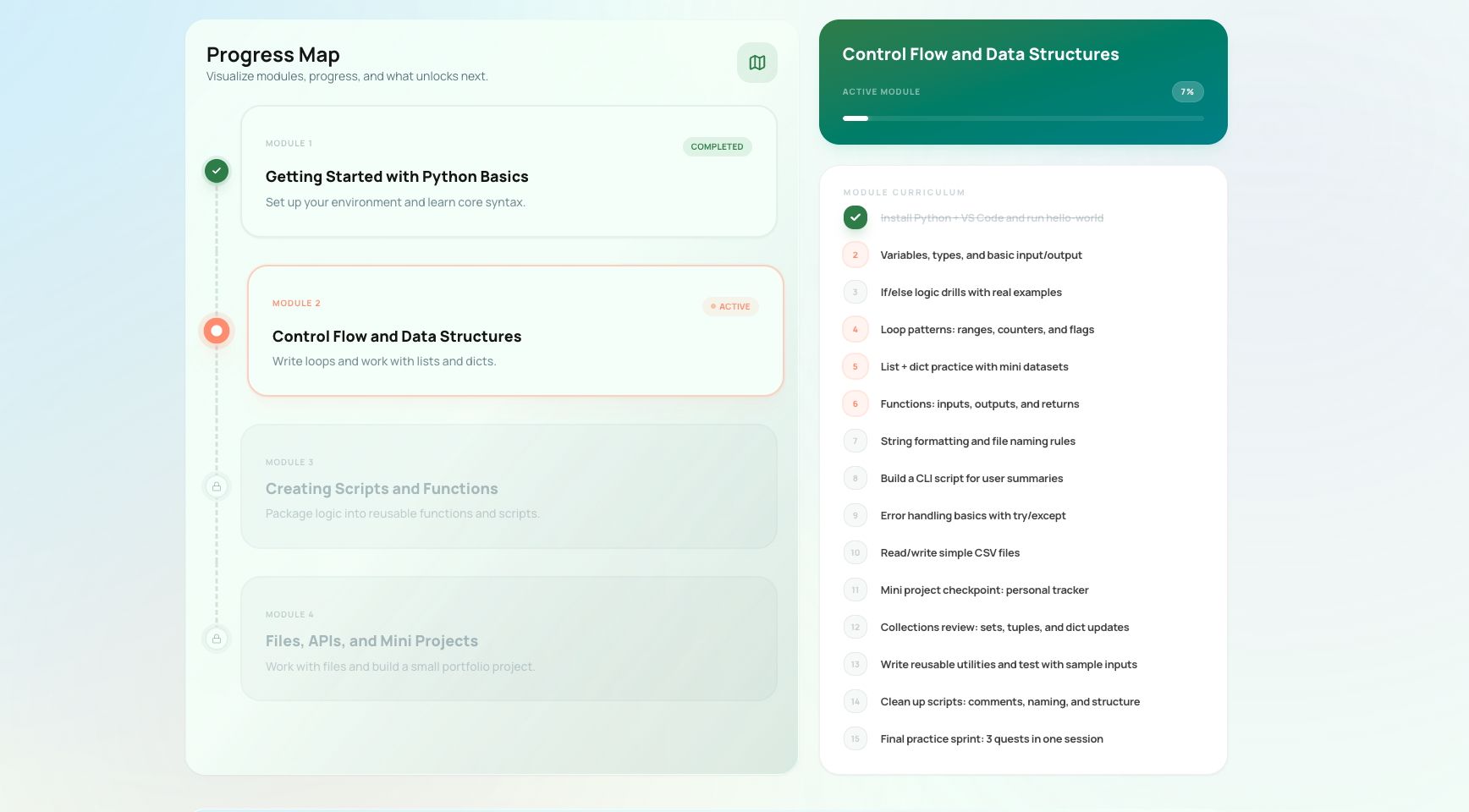
That is useful when the real threat is not lack of ambition. It is friction at the exact wrong time.
FAQ
Is doomscrolling after work always bad?
No. Intentional scrolling is not the issue. Open-ended scrolling that quietly deletes the time you meant to use is the issue.
Should I quit my phone completely in the evening?
Usually no. A full ban is often harder to sustain than a protected first 20-30 minutes. Start by defending the transition window before you try bigger rules.
What if I am genuinely too tired to do anything useful?
Then your Floor should be tiny. One flashcard set. One paragraph. One mobility drill. One bug note. If even that keeps failing for weeks, the problem may be overload, sleep debt, or burnout rather than phone behavior alone.
What is the fastest fix that actually works?
Pre-decide the task, remove the phone from the first part of the evening, and start with something small enough to begin before your brain can bargain its way back into the scroll.
Ready to Turn Your Goals Into Daily Action?
Kognivu is an AI-powered life coach and daily planner that does exactly what this post describes: it breaks your goal into a structured roadmap, then delivers clear daily quests to keep you moving.
Build your execution plan and start immediately. Plus and Pro include a 3-day trial.
Written by
Ilia Sorokin
Founder of Kognivu. Writes about personal goal planning and reviewing AI-generated plans.
About the authorNext step
Need product path, not just theory?
If goal tracking apps keep showing data without changing behavior, Kognivu offers a more active execution-first alternative.
Explore Alternative to Passive Goal Tracking AppsContinue Reading
More from Productivity Systems