The Productivity Paradox: Why Doing Less Leads to More Success

Eliminate performative busyness. Learn how to optimize for high-impact results by managing cognitive energy instead of time.
Table of Contents
The Busyness Trap: What is the Productivity Paradox?
The Productivity Paradox is the biological and strategic phenomenon where increasing your volume of tasks leads to a massive decrease in high-value results. It occurs when you mistake 'Performative Busyness' (emails, Slack, checked boxes) for actual effectiveness. To solve it, you must shift from managing time to managing cognitive energy, ruthlessly eliminating the 80% of activities that produce zero directional velocity.
True productivity is not about managing time; it is about managing Cognitive Energy and Strategic Alignment. Success requires the discipline to stop doing the 80% of activities that provide only 20% of the results.
The Psychology of the Planning Trap
Founder's Note: I fell into this trap for years. I would end my day with 20 checked boxes on my to-do list and feel like a hero—but my company hadn't grown an inch. I was busy being busy. I realized that my brain was using "small wins" to avoid the one high-stakes, uncomfortable task that actually mattered. I had to learn that an empty inbox is often just a sign that you're ignoring your real work.
The human brain has a complicated relationship with planning. When we write a long to-do list, the brain releases a micro-dose of dopamine, creating the illusion of progress. This is the Planning Fallacy. We mistake the intent to work for the execution of work.
The Tyranny of the Urgent
Human biology is wired to respond to immediate stimuli over long-term strategic goals. This was a survival mechanism in our evolutionary past, but in a digital workspace, it leads to permanent reactivity. When your day is a sequence of "urgent" interruptions, your prefrontal cortex never has the chance to engage in deep, creative problem-solving. You pay a constant Executive Function Tax by switching contexts, which can reduce your total productive capacity by up to 40%.
The Fear of White Space
For many high-achievers, an empty calendar feels like a failure. They fill every minute with a task to avoid the anxiety of inaction. But this "white space" is exactly where high-level insights and strategic pivots occur. Without room for reflection, you are simply a faster hamster on a wheel that may be pointed in the wrong direction.
How to Solve the Paradox in 5 Steps
To move from performative busyness to high-impact execution, you must ruthlessly architect your day for results, not volume.
- Conduct an 80/20 Audit: Identify the two activities that drive the majority of your success. If you could only work for two hours today, what would you do? Everything else is secondary.
- Eliminate Decision Friction: Stop deciding what to do every morning. Use a deterministic system where the next step is already mapped out. This saves your highest-quality energy for the work itself.
- Master the Atomic Focus Window: Instead of a 10-item list, pick one "Daily Quest." Commit to 45 minutes of absolute focus on that one task. Once it’s done, you have won the day.
- Schedule Non-Negotiable Recovery: Productivity is cyclical, not linear. High-output windows must be balanced with high-quality rest. If you don't schedule rest, your body will schedule burnout for you.
- Close the Feedback Loop: At the end of every week, analyze your output, not your activity. Did you move the needle on your high-stakes goal, or did you just clear your inbox? Data is the only cure for the illusion of busyness.
The Physics of Strategic Inaction
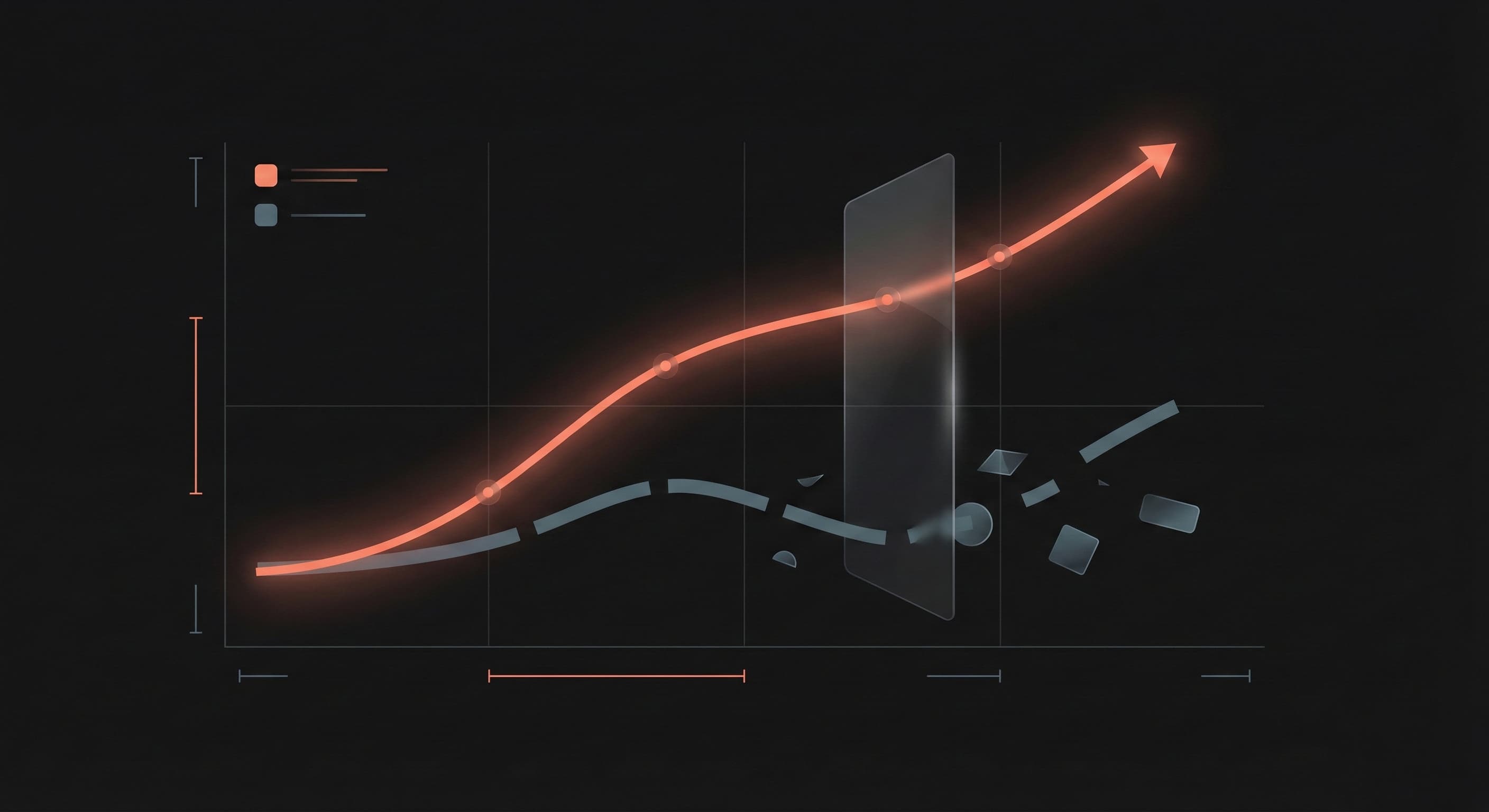
In trajectory management, progress isn't measured by how much ground you cover, but by your Velocity toward the North Star. If your trajectory is off by even one degree, running faster only gets you further from your goal.
This is why "doing less" is a strategic requirement. By reducing the number of active projects and focusing on a single Trajectory Map, you increase the "mass" of your focus. In the model p = mv (Productive Output = Mental Energy x Velocity), reducing the number of tasks allows you to apply 100% of your energy to a single vector, resulting in exponential progress.
The Trajectory Edge: Systems like Trajectory Management are designed to solve the productivity paradox. They deconstruct complex goals into a sequence of atomic, pre-decided quests. Because the path is deterministic, you don't need to "find motivation" to work; you simply follow the coordinates.
The Courage to be Unproductive
Society rewards busyness, but the market rewards results. To reach the next level of performance, you must have the courage to say "no" to good opportunities so you can say "yes" to the great ones.
The Architect's Rules for Impact
- Volume is a Vanity Metric: Focus on high-stakes output.
- Speed without Direction is Drift: Always check your coordinates.
- Rhythm is Sustainable: Marathons lead to burnout; rhythms lead to mastery.
Stop trying to do everything. Start trying to do what matters. The most productive thing you can do today might be to delete half of your to-do list and spend the afternoon architecting a better path.
Success isn't about how much you do. It's about what you finish.
Turn Priority Into Daily Execution
Build your execution plan and start immediately. Plus and Pro include a 3-day trial.
Written by
Ilia Sorokin
Expert in Productivity Systems and deterministic planning systems. Building tools to bridge the gap between ambitious goals and daily execution.
Kognivu editorial team
Next step
Need product path, not just theory?
If goal tracking apps keep showing data without changing behavior, Kognivu offers a more active execution-first alternative.
Explore Alternative to Passive Goal Tracking AppsContinue Reading
More from Productivity Systems
Execution Velocity: Why Most People Fail at Big Goals (And How to Measure Yours)

Decision Fatigue: Why Your To-Do List is Killing Your Execution