The Portfolio Website Trap: Designing Before You Have Proof

Build a credible portfolio website in 30 days after work by choosing proof first, limiting scope, and shipping before the redesign loop takes over.
Table of Contents
You can build a portfolio website in 30 days after work. The hard part is not the site. It is deciding what proof belongs on it, then refusing to turn a small career project into a private design lab.
That is the trap: starting with colors, animations, or a template before you can name the work that makes someone trust you. Weeks disappear. The portfolio stays unpublished.
This plan is for someone with limited evening time who needs a credible, live portfolio for a job search, freelance work, or a career switch. It favors a plain site with sharp evidence over a beautiful site with nothing to say.
What a portfolio website must do
A portfolio is not a scrapbook. A recruiter or prospective client should be able to answer three questions quickly:
- What kind of problem can this person solve?
- What evidence shows they have done comparable work?
- What is the next step to contact or hire them?
If those answers are buried under visual experiments, the site is not doing its job.
The order that keeps a portfolio from stalling
Most stalled portfolios follow the same sequence:
- choose a visual style
- reopen the hero section every night
- realize the case studies do not exist yet
- run out of time before anything is live
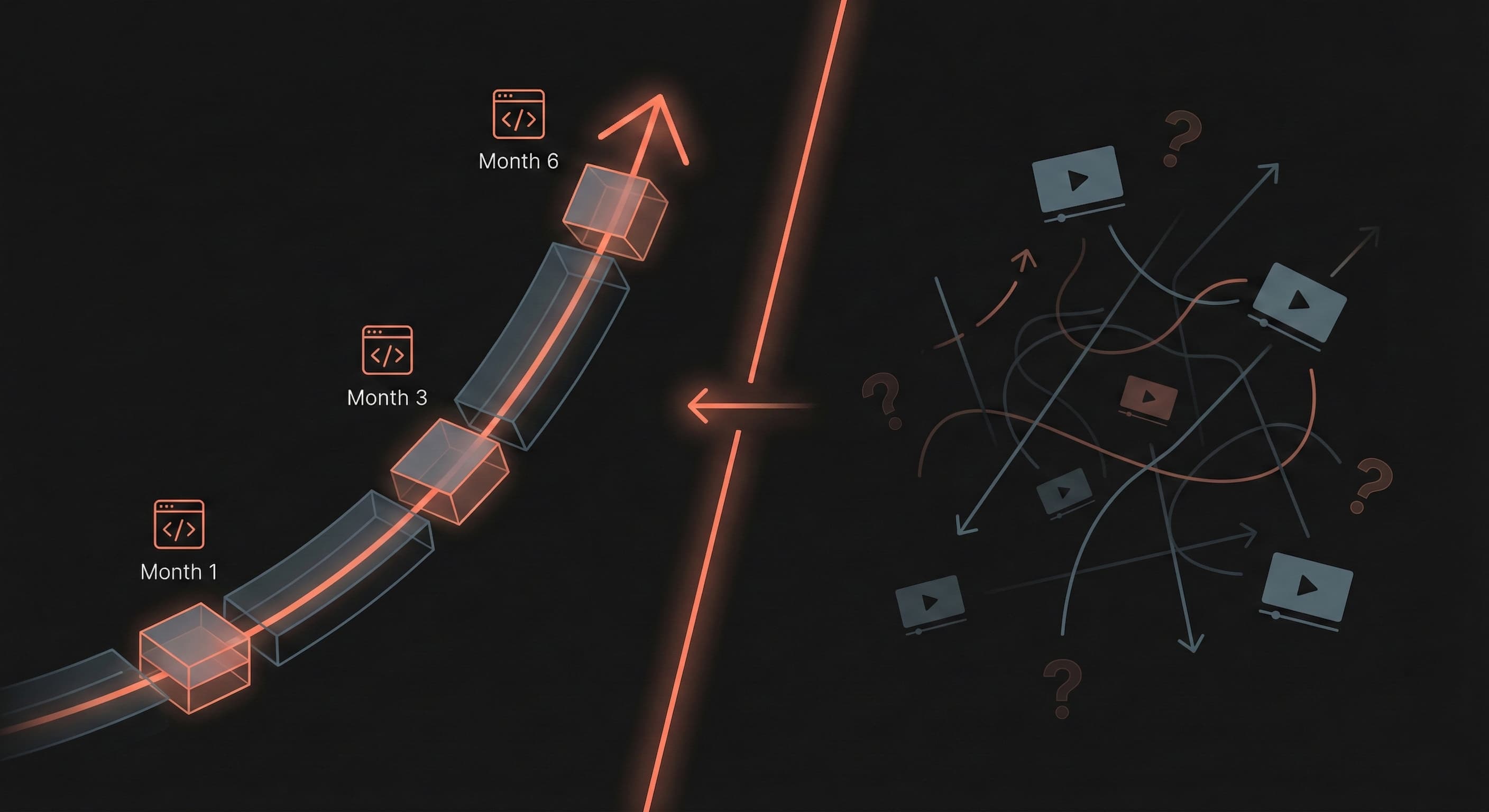
Reverse it. Write proof first, choose a simple structure second, and polish only after the site can be shared.
| Build order | First useful output | Common failure |
|---|---|---|
| Template first | A styled homepage | Endless redesign before the work is explained |
| Proof first | Two case-study drafts and a clear positioning line | Less visual novelty at the start |
| Launch first | A live, usable minimum site | Requires discipline to improve in public |
The middle path is the practical one: proof first, then a deliberately boring build, then a short launch pass.
A realistic 30-day portfolio website plan
Assume you have four or five focused evenings each week, plus a longer block on one weekend day. If your time is tighter, keep the same order and extend the calendar. Do not cut the proof phase to save time.
Days 1–4: choose a lane and a small launch scope
Write one sentence that names the audience, the work, and the evidence you want to lead with. For example: “Product designer who turns messy onboarding flows into clear, testable user journeys.”
Then fix the launch scope:
- homepage
- two or three project pages or sections
- short about page
- one clear contact path
Everything else is a later version.
Days 5–12: write the proof before touching the layout
For each project, draft these five answers:
- What was the problem?
- What constraint made it difficult?
- What was your specific contribution?
- What changed as a result?
- What would you improve next time?
You do not need a dramatic metric to have a useful case study. Be precise about the work you owned and show the artifact: a before-and-after flow, a shipped page, a design decision, a code sample, or a client outcome you are allowed to share. Do not invent numbers or turn a team result into a solo claim.
If you do not have client work yet, use an honest self-directed project. State the brief, the constraints you chose, and what you would validate with real users. A transparent case study is stronger than a polished fiction.
Days 13–20: build the smallest credible site
Choose the fastest tool that fits the role you are pursuing. If you are a developer, the implementation can itself be part of the evidence. If development is not the skill you are selling, use a dependable template or site builder and spend the saved time improving the case studies.
Use an obvious structure. A visitor should find the project work and contact route without learning your navigation system.
Before adding custom animation or a new section, ask: does this make the evidence clearer? If not, put it on a post-launch list.
Days 21–26: add credibility and remove friction
Do a short quality pass:
- replace vague labels such as “innovative” or “passionate” with concrete work
- make screenshots readable and add a short caption where context is missing
- check every link, form, and contact address
- read the site on a phone
- ask two people in your target audience what they think you do after one minute
Their confusion is more useful than another night of changing shadows.
Days 27–30: launch, then make the next improvement small
Freeze nonessential layout changes. Check the site on mobile, test every contact path, and publish it. Then send the link to people who can give relevant feedback: a peer in the field, a former colleague, a recruiter, or a prospective client.
The post-launch task should be narrow: clarify one project, replace one weak image, or improve one contact path. “Redesign the portfolio” is how the loop starts again.
Common portfolio website questions
Should you code a portfolio from scratch?
Only when the code itself supports the role you want. Otherwise, a simple tool and better proof usually beat a custom build that never ships.
How many projects should a portfolio include?
Start with two or three projects you can explain clearly. More work is not automatically more convincing; repetitive screenshots make evaluation harder.
Do you need a blog before launching?
No. A portfolio needs a clear body of work and an easy way to contact you. Add a blog later if it supports the work you want to be known for.
Keep the 30-day plan executable
An after-work portfolio project fails when every evening begins with a new decision: which case study, which page, which tool, which visual direction. Kognivu can turn the 30-day scope into milestones and small daily actions, then help you recover when a week goes sideways.
Ready to turn the portfolio plan into tonight's next action?
Build your execution plan in Kognivu and start immediately.
Written by
Ilia Sorokin
Expert in Learning & Career and deterministic planning systems. Building tools to bridge the gap between ambitious goals and daily execution.
Kognivu editorial team
Next step
Need product path, not just theory?
Use Kognivu as a daily planner for goals when a normal to-do list is not enough. Build momentum with pre-decided quests and measurable execution.
Explore Daily Planner for Goals That Need Real Follow-ThroughContinue Reading
More from Learning & Career