AI Priority Planner: How to Decide What Matters Next

An AI priority planner should decide what matters now, protect your critical path, and cut fake urgency. Learn the framework that actually works.
Table of Contents
If you are searching for an AI priority planner, you probably do not need another app that lets you label tasks as high, medium, or low.
You need help with the harder moment.
The moment when five things look important, three things have deadlines, two people want answers, and your actual goal is quietly getting buried under noisy urgency.
That is where normal planning advice starts sounding thin.
"Just prioritize better" is not useful when the problem is not effort. The problem is that your work has no stable ranking logic once the week gets messy.
This is why the category matters. A real AI priority planner should not just sort tasks. It should help you protect the critical path, shrink ambiguous work, and tell you what deserves your next hour.
What is an AI priority planner?
An AI priority planner is a planning system that ranks work by outcome impact, timing, and dependency instead of just due date or gut feel. The useful versions do not stop at labels. They explain what matters now, what can wait, and what should be cut.
That last part matters more than most product pages admit.
Many tools call themselves AI planners because they can rewrite your list, summarize your backlog, or propose a schedule. Useful features. Wrong standard.
If the app still leaves you staring at ten "important" tasks and doing your own triage at 9:12 AM, the core job is still sitting on you.
Why prioritization breaks when everything feels urgent
Most people do not have a laziness problem. They have a ranking problem.
The breakdown usually looks like this:
- A real goal exists.
- Too many tasks attach themselves to that goal.
- New requests arrive from the side.
- Shallow tasks feel easier to finish than meaningful ones.
- The day gets consumed by visible urgency instead of useful progress.
This is one reason adjacent searches like AI task planner, AI daily planner for goal setting, and AI weekly review keep showing up. People are trying to solve the same execution problem from different angles.
The hidden issue is that many priority systems rank tasks too late.
They start with a flat list, then ask you to score the items. But a flat list already lost too much context:
- which task unlocks another task
- which task protects the actual deadline
- which task only feels urgent because someone sent a message
- which task is still too vague to start
When that context disappears, prioritization turns into mood management.
AI priority planner vs to-do list vs Eisenhower matrix
These tools overlap, but they solve different layers.
| System | Main job | Where it breaks |
|---|---|---|
| To-do list | Capture and store work | You still decide tradeoffs manually |
| Eisenhower matrix | Sort by urgency and importance | Weak when tasks depend on sequence or constraints |
| Calendar | Reserve time blocks | Looks organized until the day changes |
| AI priority planner | Rank work against goals, timing, and dependencies | Fails if it only reshuffles labels |
The Eisenhower matrix is still useful. I would not throw it out. But it gets shaky when you are dealing with long projects, rolling deadlines, and work that compounds over time.
Example:
- answer three Slack threads
- finalize the article brief
- publish the landing page revision
- review one contract
All four can feel urgent. They are not equal.
If the landing page revision unlocks tomorrow's paid traffic push, that work deserves more weight than inbox maintenance, even if the inbox is louder. A decent AI priority planner should see that without forcing you to rebuild the argument from scratch every day.
What a good AI priority planner must actually do
Ignore the branding for a minute. Look for these behaviors.
1. It should rank work by outcome impact
The first question is not, "Which task is due soon?"
The first question is, "Which task most directly protects the outcome I care about?"
That sounds obvious. Most tools still do not behave that way.
They overweight:
- recency
- notifications
- shallow completion
- whatever the user touched last
A better system should anchor priorities to a declared target: ship the page, pass the exam, publish the post, finish the sprint.
If the goal is fuzzy, the ranking will be fuzzy too.
2. It should understand dependencies
This is where prioritization usually gets real.
A task can be urgent and still be the wrong next move because it is blocked, premature, or only matters after an upstream decision.
For example:
- editing copy before the angle is approved
- designing a page before the offer is final
- studying advanced SQL before basic joins are stable
A good AI priority planner should downgrade blocked work automatically and pull forward the task that unlocks motion.
3. It should force vague work into startable tasks
"Work on launch" is not a priority. It is a stress container.
The planner should keep breaking the task down until you get something you can start in under a minute.
Bad priority:
- work on investor update
Better priority:
- draft the three metrics that changed this week
- write the one paragraph on product risk
- send the draft for review by 4 PM
This is where prioritization and task design meet. If the unit of work is vague, the ranking is fake.
4. It should protect real capacity
A serious planner should know the difference between:
- what matters most
- what could matter this week
- what definitely does not fit today
That third bucket matters. A lot.
People lose trust in planners when the "priority list" still assumes six hours of focused work on a day that has ninety usable minutes. That is not a plan. It is self-deception with a nice interface.
5. It should cut fake urgency
Some tasks are urgent because they are real.
Some are urgent because they are visible.
Those are not the same.
Inbox work, chat requests, and admin loops often create the illusion of importance because they produce fast social feedback. Meanwhile, the task that protects the actual goal feels slower and harder, so it keeps slipping.
A good priority planner should surface that pattern and say it plainly:
- this request is loud but low leverage
- this task is boring but deadline-protecting
- this item can move without damage
- this item should be deleted
That is useful prioritization.
How to prioritize tasks when everything feels important
If you want a practical workflow, use this five-step filter. It works with or without software.
Step 1: name the weekly win
Write one sentence:
If this week goes well, what concrete result exists by Friday?
Not "make progress." Not "move things forward."
Something you can verify:
- publish the comparison page
- finish module 2 of the certification plan
- send 15 qualified job applications
Priorities need a reference point. Without one, everything gets to claim importance.
Step 2: mark the tasks that directly protect that win
Go through the task list and mark only the items that move the weekly win forward.
You will usually find that the real list is smaller than the emotional list.
That is good news.
Most overwhelmed days are not overloaded with meaningful work. They are overloaded with mixed work.
Step 3: separate unlockers from followers
Some tasks create momentum. Others only make sense after momentum exists.
Example:
- approve the article angle
- draft the article
- edit the article
- publish the article
If task one slips, tasks two through four are noise. A planner that treats them as equal has already failed.
Step 4: resize the top priority until it is easy to start
If the top task still feels heavy, it is not ready.
Do not try to motivate yourself harder. Shrink the task.
Instead of:
- work on pricing page
Use:
- list the three objections the page must answer
- rewrite the headline and subhead
- compare the draft against two competitor pages
This is exactly where readers often slide from priority stress into stop overplanning and start building. They keep trying to solve unclear work with more planning language.
Step 5: cut the rest on purpose
This is the step people avoid because it feels harsh.
But if you never demote or delete anything, you do not have a priority system. You have a guilt archive.
For every non-critical item, make one decision:
- do it later
- delegate it
- compress it
- kill it
That cut creates the space your main work needs.
What to look for in the best AI priority planner
If you are comparing products, do not get distracted by chat demos. Stress the ranking logic instead.
Use this short test:
- Give the tool one real goal with a deadline.
- Add 12 to 20 tasks, including vague ones and noisy admin tasks.
- Tell it your actual time budget for today.
- Delay one upstream decision on purpose.
- See whether the ranking changes in a believable way.
The best AI priority planner should do a few things well:
- ask what outcome matters, not just what tasks exist
- identify blocked work
- turn vague items into executable next actions
- protect realistic capacity
- explain why one task outranks another
That last point is important. A ranking you cannot interrogate becomes another black box you stop trusting after one bad day.
Where Kognivu fits
Kognivu is useful here because it treats prioritization as part of execution architecture, not as a cosmetic label layer.
You start with a goal, a deadline, and a real time budget. From there, the system maps the work into modules, milestones, and daily quests. That structure matters because priority becomes easier once the work has shape.
Instead of asking, "What feels important right now?" the system can ask better questions:
- which quest protects the current milestone
- which milestone protects the deadline
- which task is blocked
- what should happen next if today gets cut in half
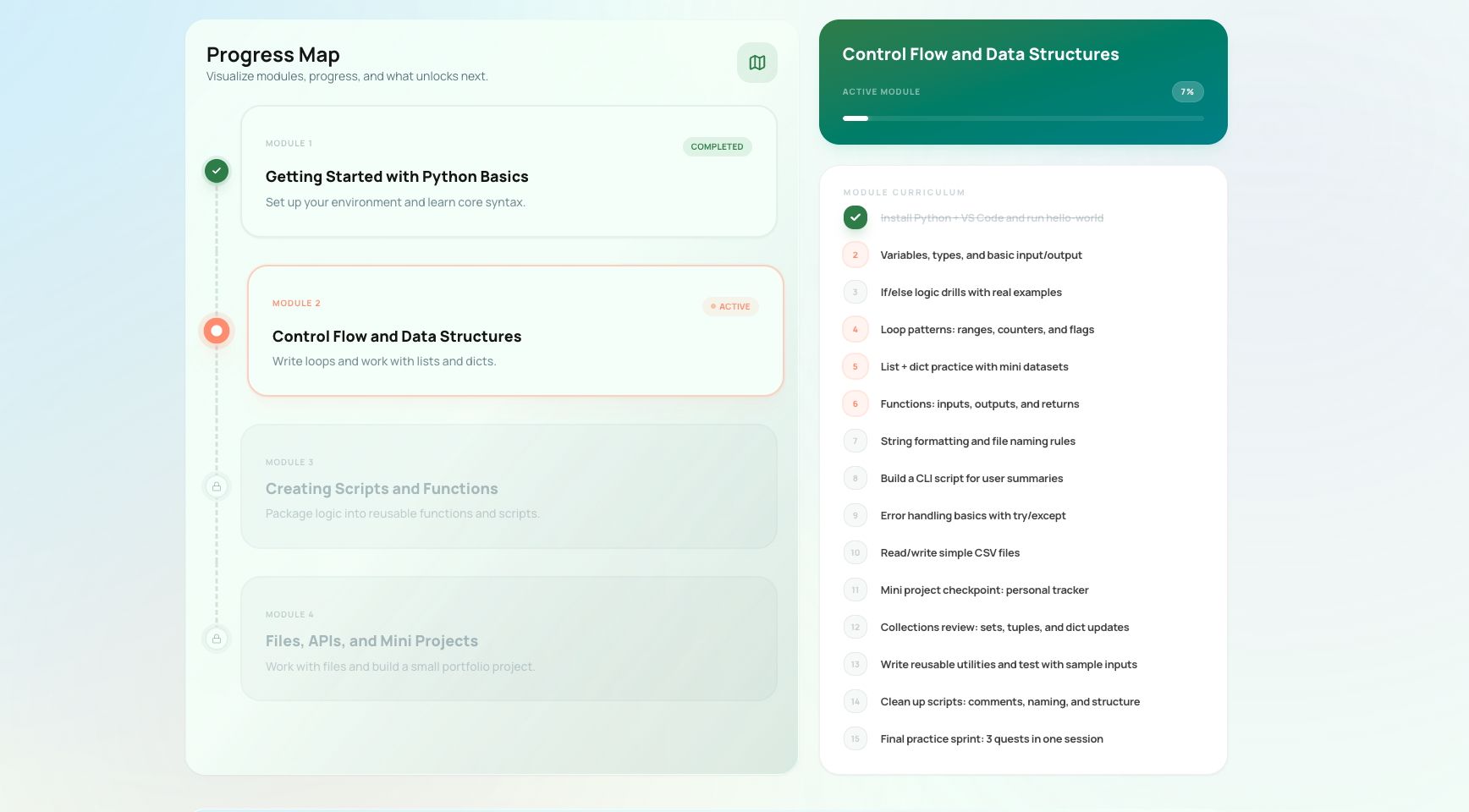
Kognivu's roadmap view gives priority context before the day turns into reactive triage.
That is the difference between a planner that stores work and a planner that helps you rank work under pressure.
If your bigger issue is roadmap quality, AI roadmap generator is the closer fit. If the problem shows up after missed days, recovery lag and momentum is worth reading next.
FAQ: AI priority planner
What is the difference between an AI priority planner and an AI task planner?
An AI task planner focuses more on turning work into actionable tasks. An AI priority planner focuses more on ranking those tasks against outcome impact, timing, and dependencies. The strongest products do both.
Can AI really prioritize better than a person?
Sometimes yes, especially when the system has full context on deadlines, dependencies, and available time. But it still depends on good inputs. If the goal is vague or the tasks are sloppy, the ranking quality drops fast.
What should an AI priority planner ask during setup?
At minimum: the goal, the deadline, the available time, and the main constraints. Without that context, the planner usually just sorts tasks by surface-level signals.
Is urgency the same as priority?
No. Urgency is about timing pressure. Priority is about what most deserves action relative to the outcome. The two overlap sometimes, but not nearly as often as stressed people assume.
Ready to Stop Letting Noise Set Your Priorities?
Kognivu helps you turn a messy goal stack into a ranked execution path with milestones, daily quests, and recovery logic when the week breaks.
Build your execution plan and start immediately. Plus and Pro include a 3-day trial.
Written by
Ilia Sorokin
Expert in Productivity Systems and deterministic planning systems. Building tools to bridge the gap between ambitious goals and daily execution.
Kognivu editorial team
Next step
Need product path, not just theory?
If goal tracking apps keep showing data without changing behavior, Kognivu offers a more active execution-first alternative.
Explore Alternative to Passive Goal Tracking AppsContinue Reading
More from Productivity Systems